
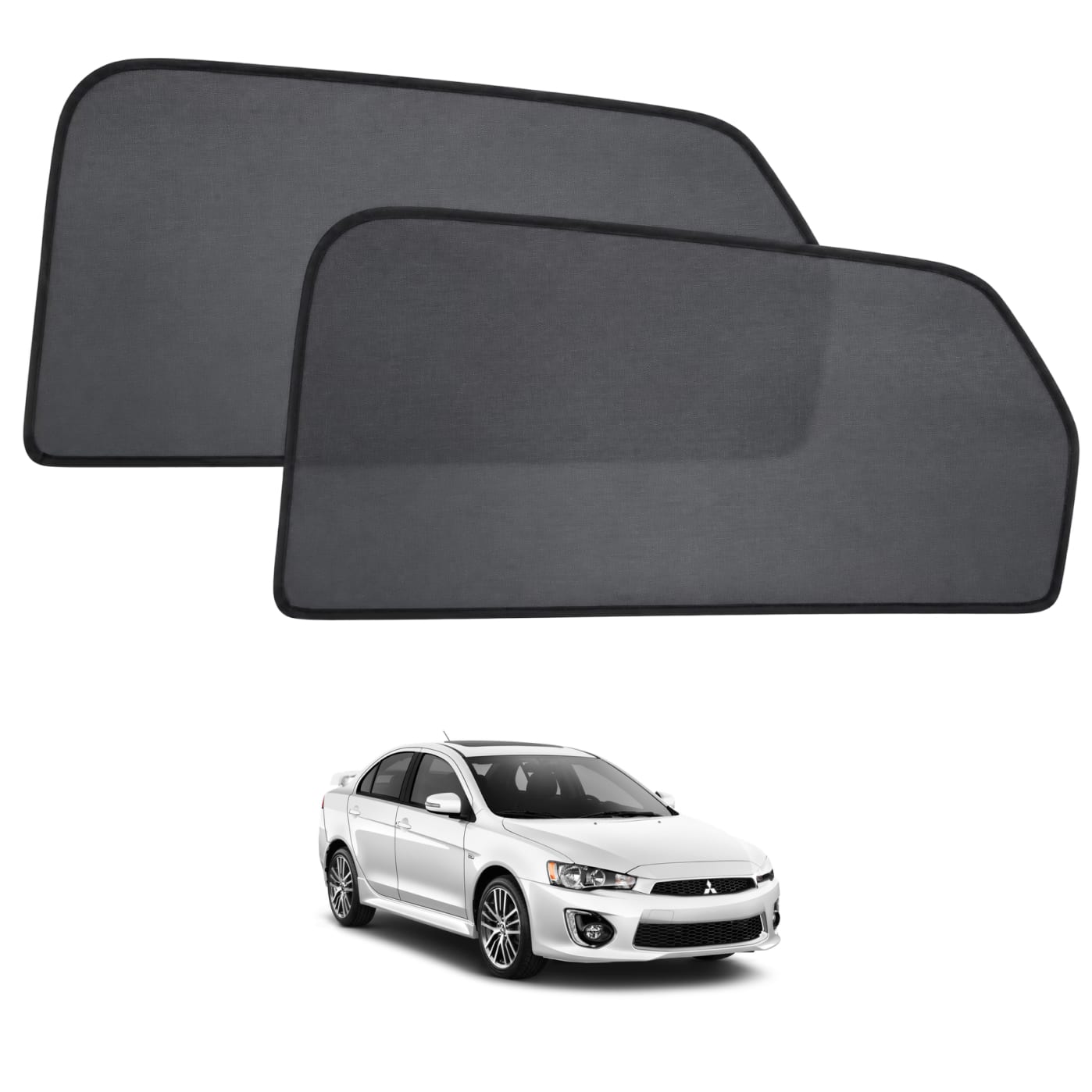
Start with the glass, because the glass is the only part of this that can be checked. The rear door windows on a Mitsubishi Lancer from the first years of the 2000s are small, close to rectangular and barely curved. The frame around them is steel and runs the whole way around the opening — exactly the surround a magnetic panel wants: continuous, ferrous, and near enough to flat that a panel laid against it settles down instead of bowing away at one corner.
The assumption usually runs the other way. Newer cars are harder to shade, not easier. Door glass on a recent sedan is more deeply curved, tapers harder towards the rear, and shares its opening with speaker grilles, camera housings and trim that laps over the frame edge. A car drawn when a door was mostly a box with a window in it gives a panel a simpler job: fewer intrusions, less curvature, no argument about where the panel stops.
So if the geometry is the easy part, why is a car this age so badly served? Not for engineering reasons. A pattern gets cut because someone expects to sell enough sets to justify cutting it, and a Lancer built between 2000 and 2003 is never going to be a big line. There is no partial version of that decision — the pattern either exists or it does not. Where it does not, the owner of a car that still starts every morning is left with universal shades, the suction-cup rectangles that cover most of a window and shade none of it properly, plus a gap wherever the glass tapers.
Age is a commercial problem, not an engineering one.
There is a second trap here, and it is the badge. Lancer ran through several distinct generations, and the cars are not interchangeable across them — the CG and CH era of the early 2000s has different doors, different glass and a different frame from the CJ that came later and stayed for years. The nameplate outlived several cars underneath it. Anything advertised as fitting “a Lancer” is telling you almost nothing; the year range is doing all the work, and it is the part worth reading twice.
This is the product render for the set, not a photograph of one fitted to a Lancer. We have no fitted images of this car, and would rather show the render honestly than imply otherwise.
What we hold on this one is thin, and it is better to say so than to dress it up. A full set — two front panels, two rear — was supplied for a 2000–2003 Lancer to E.H. in New South Wales in July 2026. That is the whole of it: initials, a state, a month, and one line naming four panels. Nobody was asked what they made of it, so nothing of the sort is reported here. Read it as evidence that coverage exists for this car — the oldest by roughly two decades in the batch of supply notes we have been working through.
We have some affection for cars at this end of the age curve, and not for sentimental reasons. A twenty-year-old Lancer is a cheap, serviceable, unremarkable thing doing precisely the job it was bought to do, usually for someone with no intention of replacing it. Shading the glass on a car like that is one of the few improvements that costs little, needs no tools, and comes off completely when the car changes hands. It ought to be easy to buy, and mostly it is not, which is why a pattern cut for this generation is worth noting. We list the set for the 2000–2003 car on its own product page.