
On a sedan, every side window is a variation of one shape: a pane that winds down inside a door frame. A people mover breaks that pattern, and it breaks it where it counts: the shade sets are divided along the same lines the body is.
What follows is a walk from the A-pillar backwards along a Kia Carnival 2020-2026, occasioned by a July 2026 order out of NSW under the initials T.K. — the only record in this group where a second panel was added for the same vehicle. It records the glass and what was supplied against it, not a customer review; nothing is held here about the buyer beyond initials and a state.
- Front doors. Start at the mirror. The front pane is the most steeply raked on the car’s flank — its leading edge leans back to follow the A-pillar, so the shape is a lopsided trapezoid, pinching to a narrow corner near the mirror sail. Structurally it is the easy zone: a conventional door sash runs all the way round the glass, the door swings through a hinge arc, and both faces are reachable in a second. A panel here has to match a rake and hold still.
- Sliding rear doors. The geometry relaxes and the mechanics tighten. This aperture is closer to a rectangle — top and bottom edges more nearly parallel, much less lean on the leading edge — so as a shape it is more forgiving than station one. What changes is that the door no longer swings: it translates rearwards on a rail. Anything fitted inside it has to sit wholly inboard of the seal and stay there through repeated cycling. Two doors back, and the job is already not four of the same thing.
- The fixed pane over the third row. Here three things change at once. There is no door: the glass is set into the body side between the sliding door aperture and the rear pillar, narrowing towards the rear as the roofline and the shoulder line converge. So there is no sash to seat a panel into, only the body aperture; no door to swing open to reach the outboard face; and no movement in the pane, so nothing can be wound down out of the way. It is also why a four-door set stops one zone short: four panels, four door apertures, and this is not a door. On this order it was covered by a second, separately listed item, which the set labels a Port window.
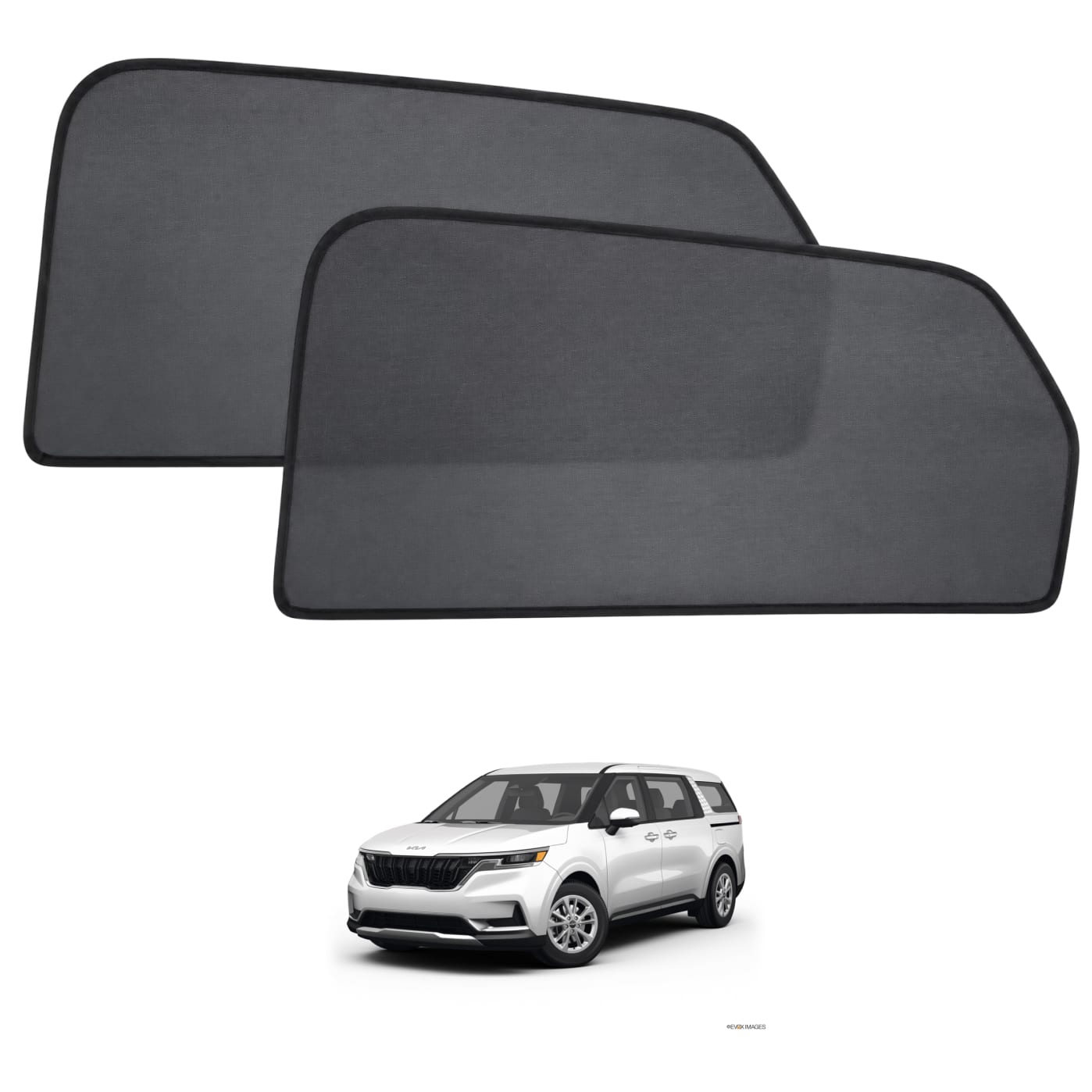
A render of the panels as they are supplied, not a photograph of a fitted car — no fitted images exist for this order.
Read as a diagram, the Carnival’s side glass is two hinged apertures, two sliding apertures, and one hole in the bodywork. A set described as 2 front plus 2 rear is being accurate about the first four. The fifth zone sits over the row that makes a seven or eight seater what it is, and it is bought separately — easy to overlook, because on a van the door count and the glass-zone count differ, and the set names count doors.
Both items on this order come off the one listing for the vehicle at CarShade, which is where the Carnival panels are available; carshade sells nothing.